Recently, after reviewing and running trial projects with multiple online platforms that source crowdsourced Korean voice actors, several critical quality challenges became apparent. If you are planning to build high-performance Korean TTS (Text-to-Speech) models or collect clean speech corpora, here is why partnering with a Korea-based, in-house studio operated by native experts is non-negotiable.
1. The Nuance Trap: Native Standard Korean vs. Regional Dialects
Korea is geographically compact, yet it features a remarkably rich and complex spectrum of regional dialects. Subtle accents and intonation shifts that are barely noticeable to foreigners are instantly recognized by native listeners. When companies without a physical presence in Korea manage voice projects externally, ensuring strict adherence to Standard Korean (Seoul standard) pronunciation becomes a major risk.
2. The Danger of Machine-Translated Scripts in AI Training
Many offshore projects rely on machine-translated scripts, often resulting in awkward phrasing or unnatural sentence structures. While professional voice actors can improvise to a certain extent, it creates logical inconsistencies. For example, forcing a cheerful tone to deliver a conflicting emotion like "I am sad" creates corrupted contextual data. Can your AI model truly learn natural human emotion from misaligned and unnatural audio-text pairs?
3. Home-Recording Quality Inconsistencies vs. In-House Studio Standards
Many platforms rely on decentralized home-recording setups. Even with professional voice actors, mixing home-recorded audio patches into a larger corpus introduces acoustic mismatches (room tone, microphone variance, and frequency imbalance). In our studio operations, even when minor pickup lines are recorded at home, they often fail to match our high-end studio grade, forcing us to re-record them on-site. For large-scale AI datasets, acoustic consistency across all speaker files is critical.
4. The Power of Korea's Unique Broadcast & Talent Ecosystem
Working with a verified local studio eliminates these quality risks entirely.
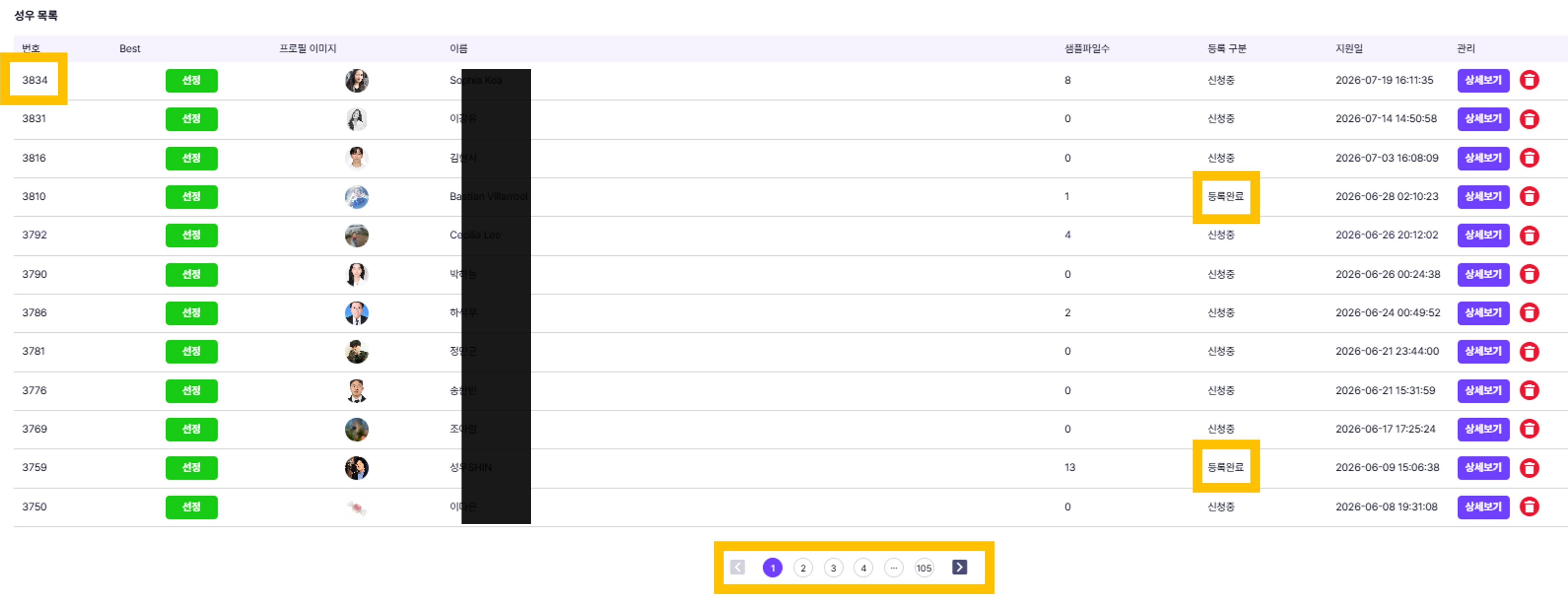
- Professional Talent Pool: Korea features a unique public broadcaster (KBS, MBC, EBS, etc.) open-recruitment system, meaning the vast majority of our voice actors have undergone rigorous, formal professional training.
- Strict Quality Control: Our database includes over 300 vetted voice actors, many with 5 to 10+ years of professional experience. We receive over 100 applications annually, maintaining a strict 15-20% passing rate through our internal evaluation. Furthermore, top-tier talent regularly transitions through Korea's official broadcast associations, ensuring elite industry standards.
5. Proven Track Record in Korean AI Voice Data Supply
As global interest in K-content and Korean AI localization surges, many overseas platforms attempt to offer Korean voice data. However, collecting high-purity TTS and STS (Speech-to-Speech) datasets requires deep localization infrastructure.
Instead of taking risks with unverified overseas vendors, partnering with an established, Korea-based studio with a proven track record in delivering commercial Korean AI voice datasets ensures accuracy, compliance, and superior model performance from day one.